Manufacturer
Matsuda Electric Works Co., Ltd. (Head Office Factory / Logistics System Construction)
Challenges
- The increasing volume of logistics operations had reached the limits of labor-intensive manual handling.
- Multiple storage locations and manual load consolidation by destination increased operator burden and risk of errors.
Results
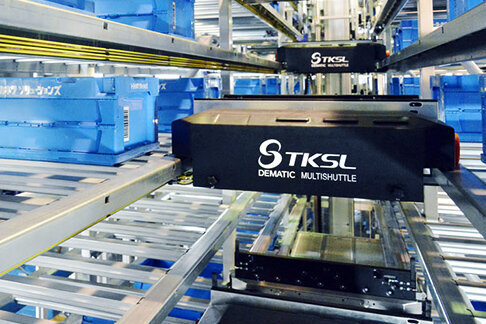
- Introduced the Multishuttle case automated storage system to centralize storage and enable automated retrieval from a single location.
- Enabled temporary storage of all finished products—both in-house and outsourced—achieving both efficiency gains and labor savings.
- Managed shipment timing via WCS (Warehouse Control System), allowing automatic retrieval at the appropriate time and significantly reducing errors.
- Adopted flex Multishuttles to accommodate a wide range of case sizes.

Background Confronting Logistics Challenges in High-Mix, Low-Volume Production
Background
Confronting Logistics Challenges in High-Mix, Low-Volume Production
Matsuda Electric Works manufactures thousands of switch types used in automobiles. Operating under a high-mix, low-volume production model, the company is required to supply products to multiple manufacturing plants. As a result, logistics operations had become increasingly burdensome, with many processes heavily dependent on labor-intensive manual handling.
In addition, outsourced products and in-house products were stored in separate locations. Tasks such as relabeling shipping documents on each floor, relocating stored items at the time of shipment, and consolidating loads by destination were all performed manually. This not only imposed significant operational strain but also raised concerns regarding the risk of errors.
To resolve these challenges, the company took the opportunity presented by the launch of its new factory to examine automation solutions aimed at improving logistics efficiency.

Why We Were SelectedVersatility in Case Sizes and Strong BCP Support
Why We Were Selected
Versatility in Case Sizes and Strong BCP Support
To address these challenges, Matsuda Electric Works selected TOYO KANETSU’s Multishuttle case ASRS (Automated Storage and Retrieval System). Key factors included its outstanding speed and flexibility, as well as its ability to handle a wide variety of case sizes through the Flex Multishuttle—an advantage not offered by other suppliers.
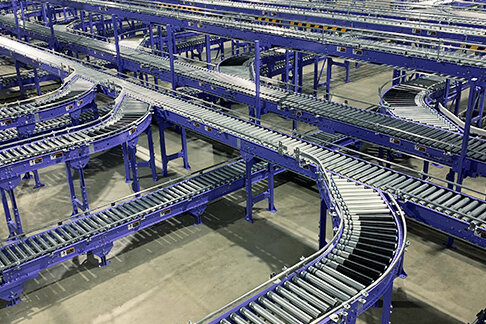
By adopting Rapid Pass, which eliminates the need for complex conveyor layouts, the system achieved highly efficient storage and retrieval within a minimal footprint.
Even in the event of a disaster-related shutdown, products can be manually retrieved from the racks, supporting business continuity and ensuring stable production and delivery operations.
Click here for related products

OperationCentralized Storage Utilizing Vertical Space
Operation
Centralized Storage Utilizing Vertical Space
Following implementation, logistics operations were significantly streamlined and operator workload was dramatically reduced. In-house products are conveyed from the third-floor production lines, while outsourced products are transported from the first-floor truck berth, and both are temporarily stored in the Multishuttle system. During inbound processing, operators are not required to consider item sequencing, allowing even less-experienced staff to handle the task.
Shipments to automotive manufacturers occur multiple times per day at fixed times. Shipment data is managed through the Warehouse Control System (WCS), ensuring that shuttles and lifters automatically retrieve products at the appropriate time.
Products are transported via a vertical conveyor to the first-floor truck berth, where operators simply wait at the dispatch point to receive items already consolidated by customer. The automation provided by the Multishuttle system eliminated complex manual handling, resulting in simplified operations and zero shipment errors since start-up.

Annual Cost Reduction in the Tens of Millions of Yen
Annual Cost Reduction in the Tens of Millions of Yen
The introduction of the Multishuttle system enabled a reduction in logistics personnel while strengthening distribution capabilities, resulting in annual cost savings in the tens of millions of yen—representing the true realization of Logistics DX.
Real-time management of accurate inbound and outbound data now supports more effective production planning. With its scalable architecture, the Multishuttle system is well-positioned to accommodate future business growth and further enhance both logistics and manufacturing operations.
* This article reflects information as of July 2025.
Products and Services Introduced